Research · 21 August 2026 · 15 min read
Paid to Stay: What the metaDEX Model Pays, and What It Costs
Aerodrome took $48.1m in trading fees over the six months to 21 August. Of that, $29.3m went to people holding locked positions, $18.8m stayed with liquidity providers who chose to keep it, and nothing was intermediated by a treasury or a team. Six dollars in ten reached a token holder.
Uniswap took $336.3m over the same period, seven times as much, and routed $27.7m of it to its holders — eight dollars in a hundred. Those fees accumulate in a contract they can only leave when UNI is burned, and over the same window 7,754,000 UNI went to the burn address, worth about $26.5m at the period's mean price. So effectively all of the money routed there was converted, and no ordinary holder had to do anything to make it happen.
Same business, seven times the share of incoming fees reaching holders, and two entirely different ways of getting it there. After six years the difference has stopped being academic.
Aerodrome is the clearest instance of a pattern rather than a special case. Twenty-one venues run this design across fifteen chains. The six whose escrow state we read directly hold $574m between them, and they all share the property that matters: the fees go to a position somebody holds, not to a treasury and not into a buyback.
Our view, up front: economic design decides these markets, and it decides them late. Day one goes to whoever has the volume, the brand and the integrations, which in 2020 was Uniswap by a distance, and back then the design question looked like an accounting preference. It isn't. It determines who ends up owning the venue, whether the people producing its volume hold any part of it, and what form the return takes. Uniswap has plenty of levers left and is pulling them: sequencer fees on Unichain, fee discount auctions that recapture MEV, aggregator hooks, and zeroing its own interface and wallet fees to grow volume. What it does not have is a way to hand a liquidity provider an ownership stake, because it does not issue UNI to anyone. That is the asymmetry, and it is narrower and more durable than the claim we made first.
There is $574m of measured locked value across the metaDEX venues we read directly, in a vertical of 21 on 15 chains. Here is what the numbers say, and what happens next month that could undo it.
What "all fees to voters" leaves out
Some metaDEXes will tell you that their trading fees go to voters, and that is true, with a condition attached that carries weight: the liquidity has to be staked in a gauge.
Stake, and you hand over the fees your liquidity earns and, in the case of Aerodrome, take AERO emissions instead. Don't, and you keep almost all of those fees, with a slice going to lockers regardless. So the venue is built to convert liquidity providers into token holders. One route pays you in the protocol, the other pays you in cash and leaves you owning none of it.
The split tells you where the fees came from. Of the $48m, $27m came from gauged pools and every dollar of it reached lockers. The other $21m came from ungauged pools, whose providers kept $19m and passed $2m along. So 57% of the measured fees came from pools whose providers had handed the fees over.
That is a statement about fees, not about liquidity. Fee production per dollar of liquidity varies enormously with pool composition, fee tier, how much of a concentrated range is actually in range, and how much volume routes through it - and gauged pools are the ones emissions are steering volume into, so they are plausibly more fee-productive per dollar than ungauged ones.
It is also not a clean vote for the token over the cash. A staked provider takes AERO emissions and can sell them the same day; plenty will have staked because the emissions were worth more than the fees they gave up, not because they wanted to own the venue. What the $19m does say is that the providers behind 43% of Aerodrome's fee base looked at that trade and kept nearly all of the cash.
Nest, over on HyperEVM, deletes the choice. Its liquidity providers are paid in NEST and see no fees at all, so lockers take everything by construction. Same mechanism, optionality removed, and worth watching as a control. If forcing buy-in builds a better business, the rest of the sector will copy it within a year.
The model contains Uniswap
There is a part that should worry Uniswap.
An LP can arrive at Aerodrome, never stake, never touch the token, keep their fees and behave exactly as they would on Uniswap. That business is running today at 43% of Aerodrome's fee base. On top of it sits a second offer: hand the fees over, take emissions, lock them, receive cash every epoch. Every gauge-based venue in this set works that way, on Base and on HyperEVM among the ones we read directly, which means the offer is being made to liquidity providers on more than one chain that matters.
These venues are not competing with Uniswap's core product. They contain it, and then add something Uniswap cannot match without charging its own users for the privilege. A venue offering your current deal unchanged, plus an apparent upgrade you can take or ignore, is a much harder thing to fight than a rival.
Which is why liquidity is the whole game. If the superset wins on liquidity, the model wins by default, because the incumbent gets hollowed out by its own users migrating for a deal that costs them nothing to try.
Two ways to end up holding the token
The two venues build their holder bases in opposite directions, and almost nobody talks about it.
AERO is emitted continuously to liquidity providers who stake. You earn the token by doing the work the venue needs, then lock what you earned to receive fees. So issuance keeps directing new ownership at the people supplying liquidity - though not exclusively at them, and not permanently: AERO trades on the open market, and a veAERO position is an NFT that can be sold with its lock intact, which is the business we are in. What the design guarantees is the direction of new ownership, not the identity of every holder. That is true of VELO, KITTEN and NEST as well: the sector issues its token to the people providing its liquidity, week after week.
UNI is bought. There was a one-time airdrop in September 2020, 49m UNI to historical liquidity providers on a snapshot, and a brief liquidity mining programme that ended years ago. Uniswap has not emitted UNI to its liquidity providers since. An LP on Uniswap earns fees and never earns the token, so the only way into it is the open market, on the same terms as a stranger who has never provided a dollar of liquidity.
One venue recruits its owners from its users, weekly, forever. The other asks its users to buy in from outside, and since December has been taxing them to fund the people who did.
Two ways to get paid
Most metaDEXes pay you for staying. Lock the token, keep voting, take cash every epoch, and the position stays sellable with its remaining term intact.
Uniswap pays its holders differently. UNIfication passed in December 2025 by 125,342,017 votes to 742 and took effect three days later. A portion of fees that previously went entirely to liquidity providers now accumulates in a contract the proposal calls the token jar, and those assets can only be withdrawn by burning UNI in a second contract, the fire pit. The fire pit takes a fixed quantity of UNI, set by governance, and releases the selected assets to whoever burned it. So it is not a pro-rata redemption available to each holder: it is a trade, and searchers take it whenever the assets in the jar are worth slightly more than the UNI they must destroy to get them. There was also a one-time treasury burn of 100m UNI, a tenth of the fixed billion and roughly $596m at the price of the day, framed as compensation for years of fees the token never saw.
Ordinary UNI holders do nothing at all, and receive value anyway: searchers buy UNI on the open market to burn it, and the supply available to everyone else falls. That is a real return and we should not pretend otherwise. The difference from a locked position is the form it takes. A veAERO holder is sent cash and still owns the position afterwards. A UNI holder owns a slightly scarcer token, and turns that into money by selling. Both are value. One is income against a retained stake, the other is capital appreciation realised on exit - the same distinction as a dividend against a buyback, and it decides who the asset suits rather than which is worth more.
What the issuance costs
Cash into a position you keep is a different shape of return from a scarcer token you have to sell. That is a claim about form, and it holds. It says nothing about which pays more, and comparing $29m of distributions against a burn is not an answer, because one of those is funded partly by printing the thing being distributed.
So, over the same six months to 21 August, read from the tokens themselves:
| Aerodrome | Uniswap | |
|---|---|---|
| reached holders | $29m in fees | $26.5m of UNI removed |
| token supply | +120,113,632 AERO (+6.51%) | fixed at 1,000,000,000 |
| issuance at the period's mean price | ≈$49.2m | none |
Aerodrome issued roughly $49m of new AERO while distributing $29m of fees to locked positions. Uniswap issued nothing and took $26.5m of UNI out of circulation, which reconciles to within 5% of the $27.7m of protocol fees routed to the jar — an independent check that the fire pit does what its documentation says.
Read strictly, a locked position received $29m of cash over a window in which its token was diluted 6.51%, and the AERO issued to do it was worth about $49m — more than the cash that went out. The income is real, and part of what pays for it is the holder's own share.
Three things stop that being the last word, and none of them is a quibble. Dilution is a transfer rather than a loss — it moves value from existing holders to the liquidity providers earning emissions, and some of those providers lock and become holders themselves. The issuance also buys something: it is what recruited the liquidity that produced the $48m of fees in the first place, where Uniswap gets its depth from incumbency and integrations it does not have to pay for weekly. And the market absorbed it — AERO rose from $0.31 to $0.48 across the same window, dilution included.
A distribution funded by issuance is not straightforwardly income, and any claim that this design pays its holders better than a buyback has to clear this table first. On these six months it does not.
Two caveats on the arithmetic. Issuance is valued at the mean of daily prices across the window, and Aerodrome's emissions are not uniform, so a token-weighted figure would be more precise. And UNI has no burn function — its supply is fixed at a billion — so the burn is measured as the balance of the address the tokens are sent to, which is why "a tenth of supply" in December described circulating supply and not a reduction in the total.
The longest lock is the default
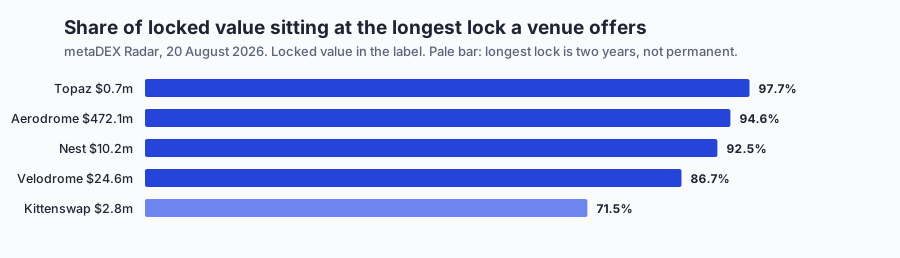
Of the $574m measured, $510m sits in venues whose lock terms reflect an actual holder base - up is left out here, because 97.3% of its locked value is one holder that the feed flags as protocol-controlled, and a chart of what holders choose should not be led by a venue choosing for itself. Of that $510m, $480m sits at the longest lock its venue offers. Where that longest lock runs indefinitely, holders take it almost without exception: Velodrome 86.7%, Nest 92.5%, Aerodrome 94.6%, Topaz 97.7%. Kittenswap, the one venue here whose longest lock is a two-year term rather than an indefinite one, sits at 71.5%.
Four venues offering an indefinite lock cluster between 86.7% and 97.7%. At Kittenswap, capped at two years, 28.5% sits short of the maximum. That is what the readings say, and it is as far as they go: with one finite-term venue left in the sample there is no basis here for claiming the expiry date is what causes the difference. Aerodrome alone is 92.5% of the value in this chart, and 82.2% of the sector's measured total, so a sector-wide reading of a handful of venues is close to a reading of one.
Which is what makes the position the liquid instrument rather than the token inside it. A holder who wants out sells the lock with its weight intact, so the sensible thing to hold is the strongest version of it, and the sector's float is now built that way by choice.
It is not only Aerodrome
Aerodrome is the primary worked example because it is the dominant venue. It is not the whole story, and the rest of the vertical is stranger than the headline suggests.
Distributions to locked positions in the week to 20 August, against the value locked behind them:
| venue | chain | to locked positions | locked value |
|---|---|---|---|
| Aerodrome | Base | $811,476 | $472.1m |
| up * | Robinhood Chain | $180,070 | $63.7m |
| Nest | HyperEVM | $66,752 | $10.2m |
| Kittenswap | HyperEVM | $7,505 | $2.8m |
\* up's locked value is 97.3% a single holder, which the Radar feed flags as protocol-controlled. So the second-largest distribution in this sector is, to a first approximation, a venue paying itself. It stays in because the figure is real and the escrow reads cleanly, but read it as one position rather than a holder base - and that is why it is absent from the lock-term chart above.
Third is a venue on HyperEVM that pays its liquidity providers nothing in fees at all. Kittenswap sends its gauged pools' fees to voters, less the 1.5% cut Algebra takes for licensing the AMM underneath, which comes out of those fees rather than sitting on top of them.
What a bad year looks like for the ve market
None of the above happened in a good market. Gross trading fees, July 2025 against July 2026 — completed months on both sides, so nothing is extrapolated:
| venue | vote-escrow | fees, Jul 2025 | fees, Jul 2026 | change |
|---|---|---|---|---|
| Uniswap | no | $88.66m | $96.49m | +8.8% |
| Curve | yes | $3.62m | $2.62m | −27.7% |
| Aerodrome | yes | $15.96m | $6.40m | −59.9% |
| Velodrome | yes | $1.06m | $0.31m | −71.2% |
| PancakeSwap | yes | $28.88m | $6.61m | −77.1% |
Uniswap's fee production grew 8.8% year on year. Every vote-escrow venue in the table fell, by between 28% and 77%. What we can say is that the sector's fee production fell hard over a year in which the largest venue outside it did not, and that the reasons are not separable from our data: chain mix, Uniswap's spread across new chains, and UNIfication's own volume incentives are all live in that +8.8%.
What is still visible is amplitude. On 19 August, when Ether moved 17.6% in a day, single-day distributions across the four venues we read directly came in at 2.0x to 4.8x their trailing average.
Aerodrome's monthly series shows how wide that swing is.
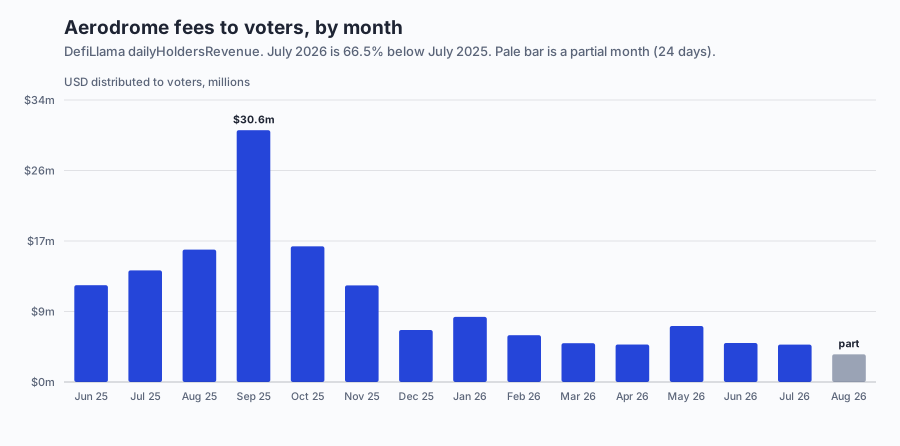
July 2025 paid $13.56m and July 2026 paid $4.54m, a fall of 66.5%. September 2025's $30.6m remains the peak, and the four months to July 2026 sat in a $4.5m to $6.8m band. Through all of it the venue kept paying, which most tokens in this market did not.
Although the token prices themselves have demonstrated they are higher beta than a lot of crypto (in both directions), they are one of the only parts of it that kept sending cash through the drawdown.
Four fifths of one market
82.2% of the measured locked value in this vertical sits in Aerodrome.
That concentration explains why almost every competitor is chain-specific. A venue on Base alone addresses four fifths of the measured market, so building for the other fourteen chains looks like charity until someone does it.
It shows up in the assets too. AERO trades 524% above its February 2024 level and 55% below its February 2025 high. VELO is 64% below where it was in September 2023, over a stretch in which Ether rose 44%. Same mechanism, same cycle, opposite outcomes. Inside this vertical, which venue you picked has mattered far more than whether you were in it at all.
Then there is September
Aerodrome is replacing weekly gauge voting with Predictive Allocation, scheduled for next month pending audits. Its own material describes what replaces it: holders allocate rewards to pools in real time rather than voting weekly on next week's emissions, and their share of revenue streams to them continuously instead of settling in a lump each epoch, with a 48-hour cooldown at first and something closer to continuous later. Alongside it sits gauge caps and emissions that adjust with trading activity.
So the voting layer is not being removed. Holders still direct emissions and still receive the revenue from what they direct them to. What changes is the cadence, and what the allocator is being paid to do: describe last week's productivity, or predict next week's. That is a smaller headline and a more interesting mechanism.
It also lands squarely on the arithmetic two sections up. Gauge caps and activity-linked emissions are capital-efficiency machinery — they address the cost of issuance, which is the thing that made the last six months unflattering. Aerodrome is fixing this before anyone made it an argument.
We are not going to call a winner. What we will say is that the structural difference is real: one design pays cash to a position you keep, the other makes the token scarcer and asks you to sell to realise it. Which is worth more is an empirical question, and on the six months measured here the escrow model's issuance cost exceeded what it distributed.
What makes the next two quarters worth watching is that all of it is about to move at once. Aerodrome changes its allocation mechanism and its emissions in September, which is the first serious attempt to fix the cost side of this design. Uniswap has a burn running against a fixed supply and a set of levers it has only started pulling. The questions we can actually answer with measurements are narrow and worth more than a verdict: does Aerodrome's issuance cost fall after September, does its fee production stop falling, does the burn keep pace with Uniswap's fees, and do the smaller venues copy the new machinery or keep the old. Every figure here regenerates from one command, so those stay answerable whenever it is worth asking again.
Figures are measured on the dates stated and are not updated in place; where a number is derived rather than read, the Method section says so. Last revised 24 August 2026.